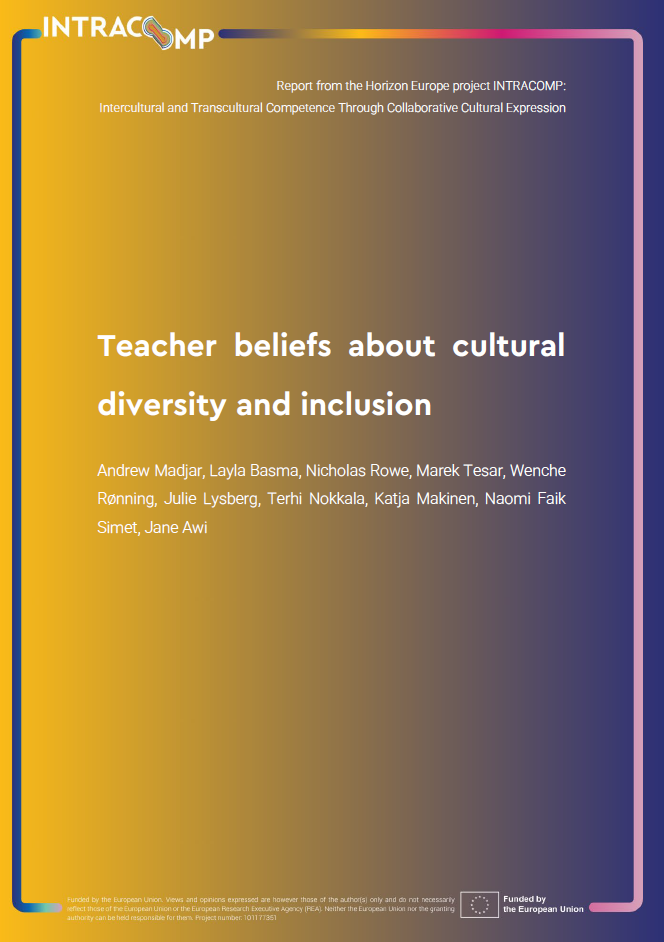
Report title: Teacher beliefs about cultural diversity and inclusion
This report is part of Work Package 5 of INTRACOMP and explores teachers’ and arts practitioners’ beliefs about cultural diversity and inclusion in formal education. Data were gathered through interviews, focus groups, and an open-ended qualitative questionnaire in Finland, Aotearoa New Zealand, Norway, and Papua New Guinea. Across these contexts, cultural differences were rarely described as obvious or fixed. Participants repeatedly talked about the limits to their own understanding of culture, and that what stands out as “differences” in a classroom depends on the teachers’ prior knowledge and experiences, and their interpretive lens at the time. Inclusion was commonly understood as something that emerges through relationships and the creation of safe spaces. Teachers also spoke candidly about barriers that sit beyond personal intentions, such as time pressures, limited resources, student dynamics, and learning environments. The findings provide a foundation for the design and implementation of the Framework’s trialling and refinement. One suggestion is that the tools for trialling the CultureComp Framework would work best as reflective, enabling dialogue and interpretation and not as a checklist of indicators.
Authors: Andrew Madjar, Layla Basma, Nicholas Rowe, Marek Tesar, Wenche Rønning, Julie Lysberg, Terhi Nokkala, Katja Makinen, Naomi Faik Simet, Jane Awi
Read and download the draft on Teacher beliefs about cultural diversity and inclusion
Disclaimer
This document is a draft deliverable produced within the framework of the INTRACOMP project, funded by the European Union under Grant Agreement No. 101177351.
Views and opinions expressed are those of the author(s) only and do not necessarily reflect those of the European Union or the European Research Executive Agency (REA). Neither the European Union nor the granting authority can be held responsible for them.
This deliverable has not yet been reviewed or formally approved by the European Commission. A revised and final version will be published following the official review process.