What does it mean to be “competent” across cultures, and can a framework really help groups, individuals, and institutions get better at it? That’s the question behind CultureComp, an intercultural and transcultural competence framework developed by the Horizon Europe project INTRACOMP (Intercultural and Transcultural Competence Through Collaborative Cultural Expression). Launched in its first version in late 2025 and updated in March 2026, CultureComp is designed to help learners, artists, teachers, and administrators identify, assess, and advance intercultural and transcultural competence (ITC) in schools and cultural organisations.
A different kind of competence framework
Most competence frameworks treat competence as something an individual acquires and owns — a trait, a level, a checkbox on a CV. CultureComp deliberately rejects that framing. Drawing on collaborators across Nord University (Norway), the University of Auckland (Aotearoa New Zealand), and the University of Jyväskylä (Finland), the framework reconceives competence as a relational, co-constructed practice that emerges between people rather than residing inside them.
This shift is visible in the framework’s first innovation: rather than centring the individual, CultureComp is built around three “ecologies”, Groups, Individuals, and Systems. Groups sit at the heart of the model (visualised as a love-heart of nested ecologies), holding up both individuals and the institutions they belong to. The logic is simple: an individual’s capacity to express ITC is shaped by the communities they belong to, and organisations, in turn, are shaped by the group relationships inside them.
Twelve competences, four clusters
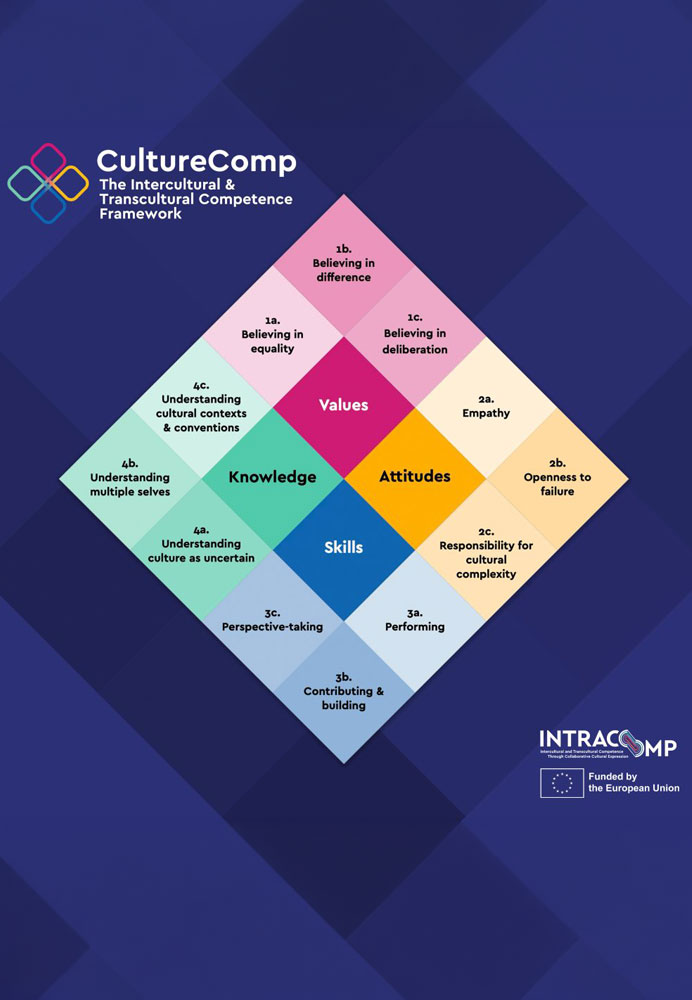
CultureComp organises its content using the familiar VASK structure, Values, Attitudes, Skills, and Knowledge, with three competences in each cluster:
- Values: Believing in equality, believing in difference, believing in deliberation
- Attitudes: Empathy, openness to failure, responsibility for cultural complexity
- Skills: Performing, contributing, and building, perspective-taking
- Knowledge: Understanding culture as uncertain, understanding multiple selves, understanding cultural contexts and conventions
Each competence comes with a description, narrative examples, reflective prompts, translation keywords, and cross-references to existing EU and UN competence databases. The narrative examples follow three recurring groups: teenagers devising a drama scene, older adults choreographing a community dance, and a women’s prison a cappella choir, giving abstract ideas a recognisable, embodied form.
Levels as openness, not mastery
Where most frameworks rate proficiency on a low–medium–high scale, CultureComp does something more unusual. Its four levels: Foundational, Fixed, Flexible, and Fluid describe a user’s openness to increasing cultural complexity, not their mastery. Foundational sits in the intercultural domain (the “groundwater” from which ITC springs), while Fixed, Flexible, and Fluid map onto deepening transcultural experiences, illustrated through a water metaphor: treading a calm lake, swimming in a river, then wading through ocean waves.
Cultural complexity itself is broken into three elements: scale (how many actors and relationships are involved), novelty (how unfamiliar the encounter is), and demand (what kind of engagement is being asked for). Crucially, the authors stress that these are prompts, not prescriptions: users are trusted to assess their own contexts.
Designed for cultural democracy
The framework’s purpose statement is explicit: CultureComp exists to support cultural democracy, the idea, articulated in the 2021 Porto Santo Charter, that democratic participation and cultural participation reinforce one another. By identifying ITC (“recognising when and where it is being experienced”), assessing it (“reflecting on how and why”), and advancing it (“making diverse experiences visible”), the framework aims to give cultural subjects, teachers, students, artists, administrators, and the communities they form a shared vocabulary for working across difference.
This matters because CultureComp is grounded in participatory embodied performing arts (PEPA) contexts: dance, music, and drama made collaboratively. The arts here aren’t decorative, they are the medium through which competence is rehearsed, tested, and renewed.
A first draft, by design
The 2026 handbook is candid that this is a “first draft” of a still-evolving tool. Future INTRACOMP work will test CultureComp across diverse cultural and educational settings, and the framework is available both as a printable handbook and as an interactive online version at culturecomp.rhizoverse.info.
What’s promising about CultureComp isn’t that it offers tidy answers about culture, it explicitly refuses to. Instead, it offers a vocabulary, a structure, and an invitation: to take cultural complexity seriously, to value the messy work of deliberation and failure, and to recognise that competence is something we practise together, in particular places, at particular moments — never something we simply have.